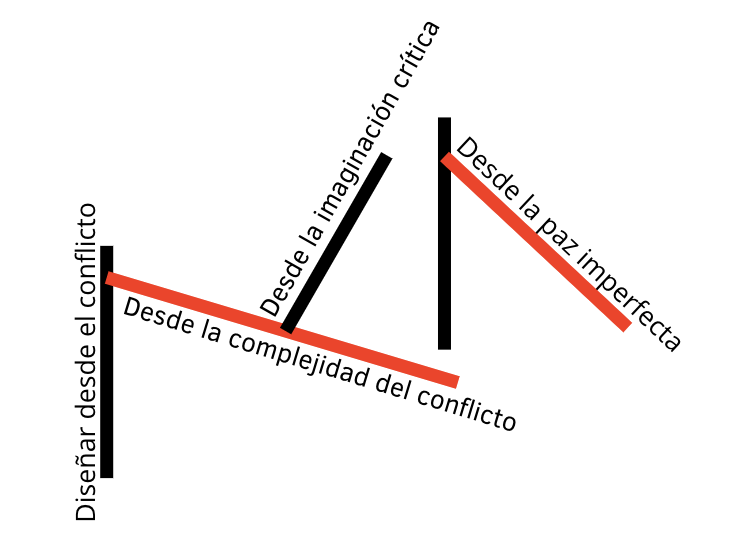
Complexity, understood as a network in which systems and subsystems are interconnected, reveals that social phenomena cannot be understood in isolation. Within this fabric, conflict is not an anomaly but a constitutive condition of human existence. Far from being merely destructive, conflict is an integral part of social and political processes and can become a catalyst for transformation, as it is linked both to power and domination and to the possibility of generating peaceful relationships and coexistence (Coser, 1961; Busquet Durán, 2017). From this perspective, the concept of imperfect peace (Muñoz Muñoz, 2004) invites us to understand that managing conflicts does not mean eliminating them, but rather transforming them into opportunities to address collective needs, even in contexts marked by persistent tensions.
Assuming conflict as an inherent component of social complexity implies recognizing its creative potential for design: opening spaces for dialogue, fostering relationships, and developing projects that strengthen hope, equity, inclusion, and non-discrimination. Designing from conflict is therefore an invitation to engage with complexity without reducing it to simplistic solutions, transforming difference into possibility and orienting design toward social justice and sustainability.
“Imperfect peace exists in all those situations in which conflicts are managed peacefully; that is, where individuals and human groups choose to facilitate the satisfaction of others’ needs while coexisting with certain forms of violence.” (Muñoz Muñoz, F. A., 2004)
Conflict plays a decisive role in the construction of individual identity, as it enables the self to differentiate itself fully from its environment. At the collective level, confrontation with other groups not only reaffirms the identity of one’s own group but also establishes its boundaries within the broader social context. Established enmities and persistent antagonisms function as mechanisms that sustain social divisions and hierarchies. These traditional conflicts, far from being dysfunctional, contribute to preserving the social visibility of groups and defining the position of each subsystem within a larger social structure (Coser, L. A., 1961).
“We must consider conflict as a common and recurring phenomenon, directly related to processes of power and domination, present throughout all historical periods and across all human cultures. Within our cultural tradition, the word conflict carries negative connotations and is often perceived as an uncomfortable reality.” (Busquet Durán, J., 2017, p. 7)
 Design Studio & Design Research Consultancy